Historically, academic excellence was defined by numerical scores and examination results. However, At St. Andrews International School, Green Valley, we recognize that today’s world demands visionary leaders who can communicate with empathy and navigate complexity with a creative edge.
This is why creative education benefits are vital; they transform students into confident communicators and responsible leaders. By fostering these essential competencies, creative education and leadership development proceed hand in hand, ensuring our students excel in an ever-changing global landscape.
What Is Creative Education?
Creative education does not refer only to drawing or playing music, as some parents may assume. It is a learning process that encourages pupils to ask questions, experiment, think beyond conventional boundaries, and connect knowledge across disciplines in a logical and purposeful way.
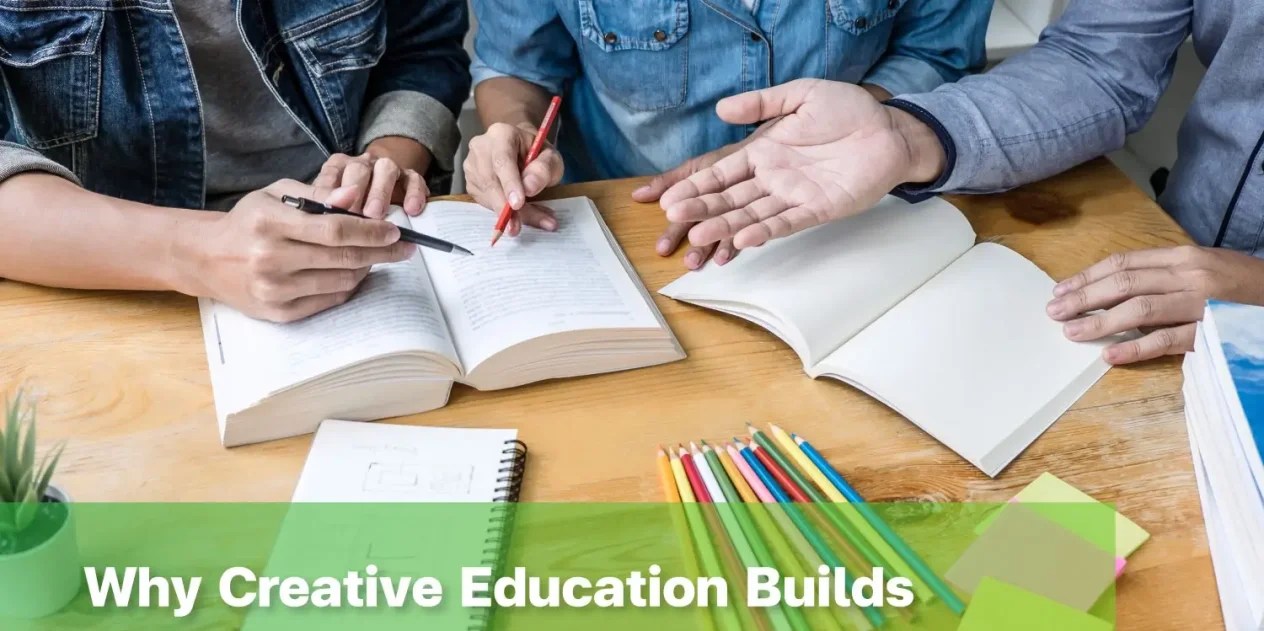
In this type of classroom, pupils are not passive recipients of information. They become active creators of meaning through activities such as:
- Project-based learning
- In-depth discussions
- Group collaboration
- Presentations
- Problem-solving in simulated situations
The Creative Education Benefits That Go Beyond Enjoyment
Before exploring leadership and communication in more detail, it is important to understand the wider creative education benefits and why they often inspire children to feel more engaged and motivated at school.
1. Building Confidence in Self Expression
When children are consistently given space to think, speak, and present their ideas, their fear of making mistakes gradually decreases. A classroom that encourages respectful questioning and discussion helps pupils recognise that their opinions have value.
They learn to organise their thoughts clearly, maintain eye contact, and articulate perspectives with clarity. This confidence extends beyond the classroom and becomes a lifelong asset. Among the most powerful creative education benefits is the ability to foster communication skills in education that support both academic and professional success. These early experiences also lay strong foundations for leadership skills for students.
2. Developing Analytical Thinking
Creative education encourages pupils to ask questions rather than wait for ready-made answers. They compare information, analyse cause and effect, and consider multiple perspectives before reaching conclusions.
This process nurtures reasoned judgement and evidence-based decision making. Analytical thinking is essential not only for strong communication skills in education but also for creative education and leadership development. Leaders must evaluate complex situations carefully, and these leadership skills for students begin forming in classrooms that prioritise critical inquiry.
3. Strengthening Collaboration Skills
Creative activities are often designed around teamwork, whether through projects, performances, or scenario-based problem solving. Pupils practise dividing responsibilities, listening to different viewpoints, and adjusting their ideas to achieve shared goals.
Through this process, they cultivate respect, empathy, and accountability. These qualities are central to creative education and leadership. Effective leadership skills for students rely on the ability to collaborate in diverse environments. At the same time, teamwork strengthens communication skills in education by encouraging clear dialogue and mutual understanding.
4. Cultivating Emotional Resilience
In an environment that welcomes experimentation and learning from mistakes, children begin to see failure not as an endpoint but as part of growth. Reflecting on outcomes after activities helps pupils build resilience, adapt strategies, and maintain a positive mindset.
Emotional resilience is one of the most significant creative education benefits. Leaders in the modern world must navigate uncertainty with composure. By embedding creative education and leadership opportunities into daily learning, schools help pupils develop leadership skills for students that are grounded in adaptability and confidence.

Creative Education and Leadership
Leaders today must think flexibly, collaborate across cultures, and make decisions in complex circumstances. Creative education provides a safe environment for pupils to practise leadership roles from an early age.
Real Responsibility in Action
In project-based or collaborative learning, pupils take on different roles such as team leader, planner, or coordinator. Managing real responsibilities teaches time management, prioritisation, and accountability.
Through these experiences, pupils understand that leadership is not about issuing instructions. It is about supporting and inspiring others towards a common goal. Creative education and leadership therefore become closely connected, reinforcing essential leadership skills for students while strengthening communication skills in education.
Practising Reasoned Decision Making
Creative tasks rarely have a single correct answer. Pupils must analyse information, evaluate options, and anticipate outcomes before making decisions.
This structured thinking builds responsibility and confidence. These are critical leadership skills for students who will one day make decisions in uncertain environments. Such experiences clearly demonstrate the long-term creative education benefits that extend far beyond academic performance.
Learning to Listen and Build Trust
Teamwork encourages pupils to listen attentively to diverse perspectives. They discover that listening is not merely polite behaviour but a fundamental tool for building trust.
When individuals feel heard and valued, cooperation and positivity flourish. These relational qualities are at the heart of creative education and leadership. They strengthen communication skills in education while shaping authentic leadership skills for students.
Communication Skills in Education as the Foundation of Success
One of the most vital competencies in the 21st century is communication skills in education. This includes speaking, writing, listening, and intercultural communication. Creative education systematically nurtures these abilities.
Discussion and Presentation
Providing opportunities for classroom discussions and presentations enables pupils to structure their ideas, choose appropriate language, and communicate with confidence. Constructive feedback from teachers and peers supports continuous improvement.
These practices highlight key creative education benefits, reinforcing communication skills in education while contributing to creative education and leadership growth.
Cross Cultural Collaboration
In international school environments, pupils often come from diverse countries and cultural backgrounds. Group work becomes an important platform for learning respectful communication and cultural sensitivity.
Adapting communication styles to suit global contexts is essential in international workplaces. Through creative education and leadership experiences, pupils develop leadership skills for students that are globally relevant and grounded in strong communication skills in education.
Persuasive Communication
Debates, project proposals, and scenario-based problem solving allow pupils to structure arguments logically, use supporting evidence, and present ideas convincingly.
They learn that effective communication is not simply about speaking fluently. It is about helping others understand and engage with ideas through reason and clarity. This represents one of the most practical creative education benefits, directly supporting leadership skills for students and future professional success.
Conclusion
The relationship between creative education and leadership demonstrates that pupils who are consistently encouraged to think, analyse, discuss, and collaborate will gradually develop communication skills in education alongside leadership skills for students in a balanced and meaningful way.
At St. Andrews International School, Green Valley, the curriculum and learning experiences are thoughtfully designed to promote creative education and leadership development. Through inquiry-based learning, interdisciplinary projects, and enrichment activities, pupils are supported in building communication skills in education and leadership skills for students at every stage.
Families who wish to see their children grow into confident communicators and capable leaders, prepared for the challenges of a rapidly changing world, are warmly invited to learn more or book a school tour today via the website.